Keynote Speech by Jonny Gonzalez at the 2026 Labor Studies Spring Celebration
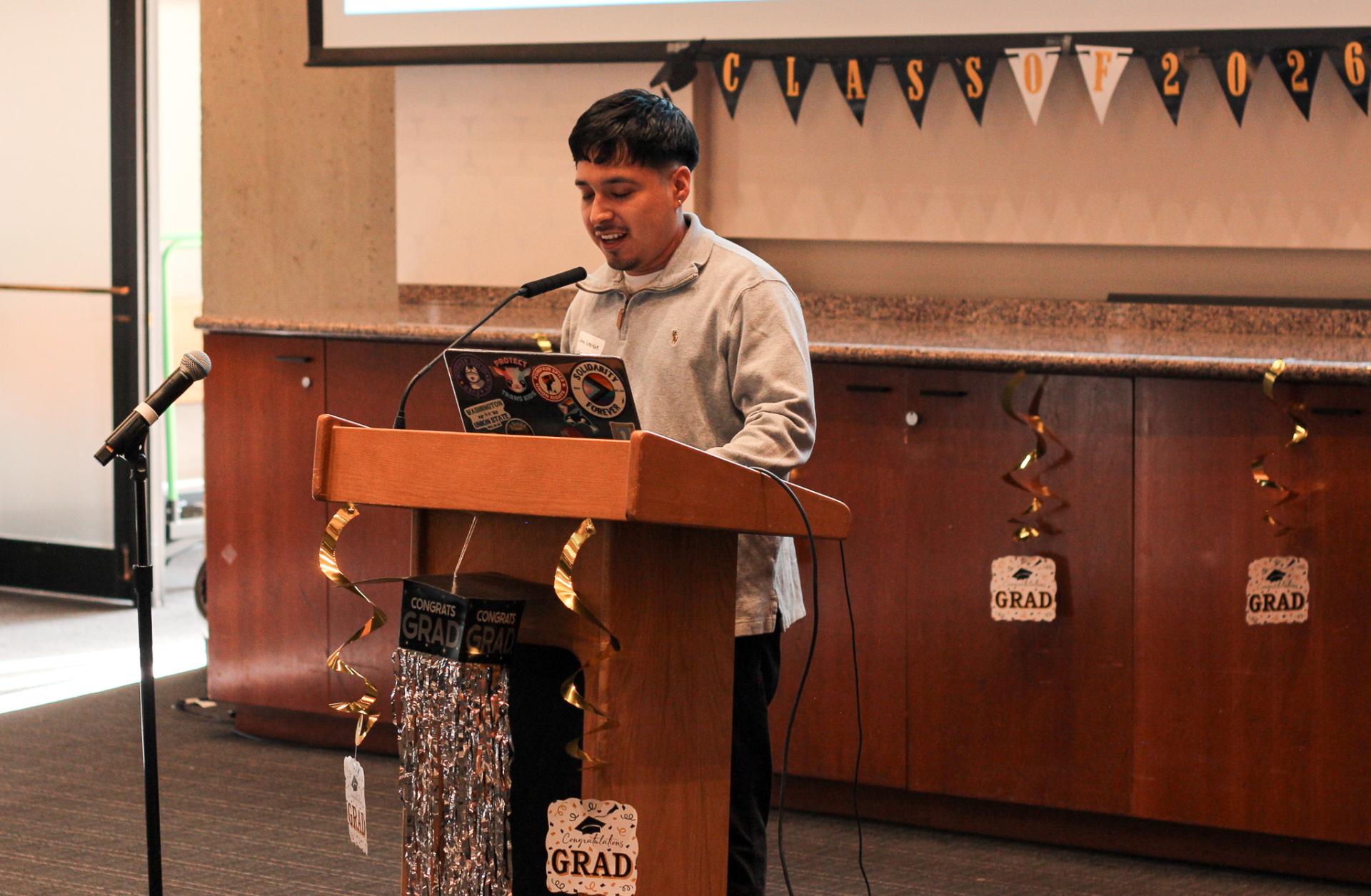
Jonny Gonzalez graduated from the University of Washington in 2023 with a double major in Political Science and Latin American & Caribbean Studies, with a minor in Labor Studies. Gonzalez was the recipient of the LERA and Samuel B. Bassett Scholarships in Labor Relations in 2022, and participated in the Building a Movement (BAM) internship, where he helped organize academic student employees alongside UAW 4121. He also organized and built meaningful relationships with different unions as an intern with the Washington State Labor Council’s (WSLC) Union Summer internship program. Today, Gonzalez is a dedicated organizer for Teamsters 117.
Wassup everyone and good evening! My name is Jonny. I stand before you as a former BAM intern, Union Summer intern, and I had the opportunity to work at the Harry Bridges Center for my senior year at UW. Currently, I work as an organizer at Teamsters 117. But before all that I didn’t have a clue about unions.
Firstly, I want to congratulate you all on making it out of this institution. Shout out to all the Labor Studies Graduates & shout out to this year’s BAM cohort! Y’all made It! And We On Top! I want to share a quick moment from my time here. As a BAM intern, we were given a labor tour on the UW campus, and Andrew Hedden had a line saying that the Bridges Center is the only department not named after a millionaire. It was a funny punch line, and it also resonated with who I was and who I wanted to be. While we all walked through the beautiful campus, I recognized that, like society, it centers wealth and capital. And so, hearing Andrew highlight who Harry Bridges was, confirmed for me that we all need a different set of values. And for those that are with me, maybe that’s why we arrived at the Bridges Center. I want to be an individual that uses a racial, gendered, and class lens in approaching life and work. And I believe that the Bridges Center equips us with the tools of intersectionality right at the moment we are preparing to navigate post-college. So, I’m honored that the Bridges Center staff asked me to speak at your Labor Studies Spring Celebration. Y’all waited a minute for this moment, so let’s clap it up for yourselves one more time.
As y’all prepare to begin your next steps and pursue opportunities, whether it’s graduate school or entering the workforce, let’s be real – change is intimidating. I want to be a transparent person and say that I knew my FAFSA money was only going to last me until August. I studied Political Science and Latin American & Caribbean Studies w/ a Labor Studies minor. So, while my studies fueled my passion, the job market was not ready for that DEI diploma. But we all know that it’s either work, struggle, or both. I knew that my moral compass ultimately leans towards social justice and my work was going to reflect that.
I wasn’t aware of the labor movement until my brother became an electrician. I had only heard about unions when my high school teachers were in negotiations. So, the value of a union wasn’t clear to me until my brother began his apprenticeship with IBEW 112. I come from a mixed status family, and the barriers facing my family were and are real. Knowing that the state stands against the existence of families like mine, and having to wonder what policies are going to change for the worse was frustrating! It is too much to learn how to constantly pivot just to stay up.
My brother is also a Dreamer. He was top of his class through grade school and was featured on the local news. I’m telling you this man got brains, but we lived in Georgia at the time and the state laws unfortunately tied legal status to every opportunity to advance. We knew the system was at work throwing out a great mind, but he still had to find a way to make it through. We moved to the Tri-Cities in Eastern Washington during the recession. He found work at McDonalds for a few years, until my dad encouraged him to apply for the IBEW apprenticeship. My brother was accepted, and the benefits of a union career were instantly clear. He was the first Dreamer to be in a cohort, and as he progressed into his career, he was able to buy a house and build a family. His union— an institution— saw through the construct of status and gave him the same opportunity as everyone else. That was the first clear benefit of the union.
The second benefit of a union career was the ability to build up savings. The ability to have a stable income and plan your future, and the ability to have an emergency fund. Now, my high school experience was a trip for many reasons, but it was also Trump’s first administration. Tensions in our community were high, and everyone was (and still is) looking over their shoulders. One evening, my mom was arrested by ICE. She was processed through Yakima before arriving in Tacoma at the Northwest Detention Center. At the same time, my family and I were searching for lawyers, while trying to keep up with her location. We had to justify her absence from work. Everything was up in the air, and this moment was destabilizing. Had it not been for my brother’s job, I may not be here today, my family would not be here together, and our lives could have taken another path. He paid $10,000 bond for her release. We made sure her job kept her position open for her return. He paid the lawyers’ fees for the rest of the case. In the labor movement, we always ask members to highlight their union difference to non-members to explain why they should join. My sister is a member of the WSNA, my brother is a member of IBEW 112, and I am a member of Teamsters Staff Union. This is my union difference.
I highlight the story of my mother and brother to explain why I’m at the Bridges Center. I was informed by my lived experiences, and I was looking for a space to create change, or be a part of conversations where we can imagine a different reality. My college experience with the Bridges Center began in my sophomore year when I took their classes, learned about their minor and the BAM internship. I was accepted and paired with UAW 4121, whose staff was extremely helpful, and focused on equity and engaged in issues facing membership. I was able to be a part of organizing conversations, a housing justice committee, and membership meetings where we review financials. It was an introduction to how a union can work. When I wasn’t with my host union, my cohort and I prepared a 'Know Your Rights' presentation for young workers. When I reflect on the activities we did, I recognize that these skills are transferable. Identifying issues, having organizing conversations, and getting out the info are all important to any campaign, including an organizing campaign. It’s important that we take ownership of the work done and feel confident knowing that no one can take that away from you. When I graduated and moved into labor spaces, I relied on what I learned from my collegiate experience.
While I accomplished a lot, I want to share that I face insecurities in the work of organizing. It is inspiring to see and hear about the stories of my coworkers. Many come from the shop floor and were rank and file. There is something incredibly special about having the knowledge of your workplace and transitioning into a role like a union rep or organizer and being on the other side of that dynamic. The creativity and ability to be real, and call folks out on their contradictions, show the real power of workers. We intuitively know how to communicate by the nature of being workers. And in those spaces, I recognize that we must approach it with an open mind and humility. Folks can see through your fronting. My union represents a lot of warehouses or public sector workers, so it will be clear soon whether you came from that line of work. Now I’ve worked in customer service, hotels, and in cherry fields and I can navigate what I know. I mention this because insecurity is only one frustration I face. In any field you enter – I wish you luck. There may be internal politics, artificial barriers, or bad faith actors. However, I was taught that if we are serious about seeing societal change, we must be a part of those organizations that exist in the intersection of workers’ lives and be a voice. We don’t do ourselves or our community any favors by becoming isolated or dying on a hill to prove a point. We have a lot to gain from fighting back, otherwise we guarantee nothing will change. As an organizer, I help workers realize the change they want to see in the workplace. It’s inspiring to see workers take charge and lifting their consciousness. In the same way, I invite y’all to be change-makers in your respective fields and use the lens the Bridges Center teaches all of us.
We are a product of the love we give and receive from those around us, and we bring them with us to every room we walk in. Maya Angelou said “It is very important that it comes from within, that you have a sense of yourself, so that when you walk into an office you don’t go alone. Bring your people with you. Bring everybody who has loved you with you.”
I want to congratulate you all once again on your accomplishments today and all those achievements you will make, thank you!